
All articles
Logistics Firms Find Stronger AI Returns By Prioritizing Revenue Over Pure Efficiency
Shan Wu, Co-Founder and CEO of breadd.ai, on why AI's real value only shines when it helps companies make money or eliminate a real budget line, not when it simply speeds up existing work.
Key Points
An efficiency-first rush into AI has left many logistics companies with a value gap, where time saved fails to create revenue, reduce costs, or change headcount in a down freight market.
Shan Wu, Co-Founder and CEO of breadd.ai, explains that AI only delivers real value when it helps companies make money or eliminate a real budget line, not when it simply speeds up existing work.
He outlines a practical path forward that focuses on revenue-driving use cases, low-risk tools that prove value before integration, and a buy-then-build model that automates repetitive work once the economics are clear.

Everybody likes saving time, but translating that into real business value requires scale. Otherwise, especially during a freight recession, saving time doesn't do you any good.

Shan Wu
The logistics industry has embraced AI in the name of efficiency, but time saved is proving to be a shaky measure of success. Companies invest in automation expecting clear returns, only to discover that faster workflows do not automatically create business value. In practice, AI often trims activity without moving revenue, leaving leaders paying the same salaries for less output. The result is a growing value gap that exposes the limits of an efficiency-first approach.
Shan Wu is the Co-Founder and CEO of breadd.ai, a platform focused on helping freight brokers win new business. A second-time founder, he previously helped build a billion-dollar business line at fintech company Xendit and began his career as a management consultant at Bain & Company. That mix of experience has made him direct about one thing: efficiency sounds great, but it only matters if it shows up in revenue or cost.
"Everybody likes saving time, but translating that into real business value requires scale. It’s most applicable when you are growing, because the person whose time you've saved now has other work to do. Otherwise, especially during a freight recession, saving time doesn't do you any good," says Wu. It's a lesson he learned firsthand, after an early attempt to sell pure automation to a cautious yet optimistic logistics industry provided a clear look at the limits of that value proposition.
The automation paradox: "My customers would tell me that while it was great that I helped automate their operations, they were now paying an employee the same salary for less output. They weren’t interested in paying thousands of dollars continuously for that result," he recalls. That feedback forced a change in strategy. The company’s new focus: generating top-line revenue.
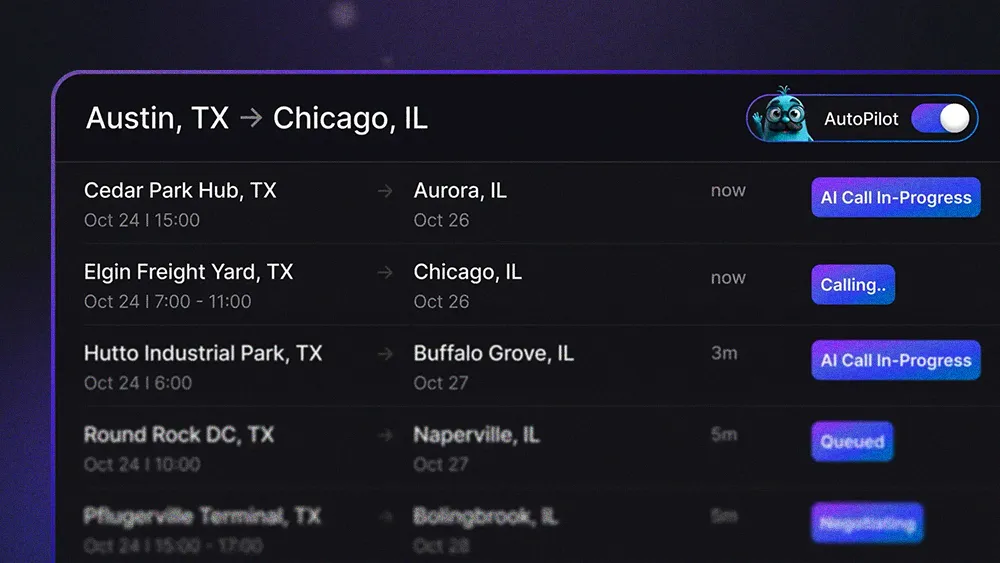
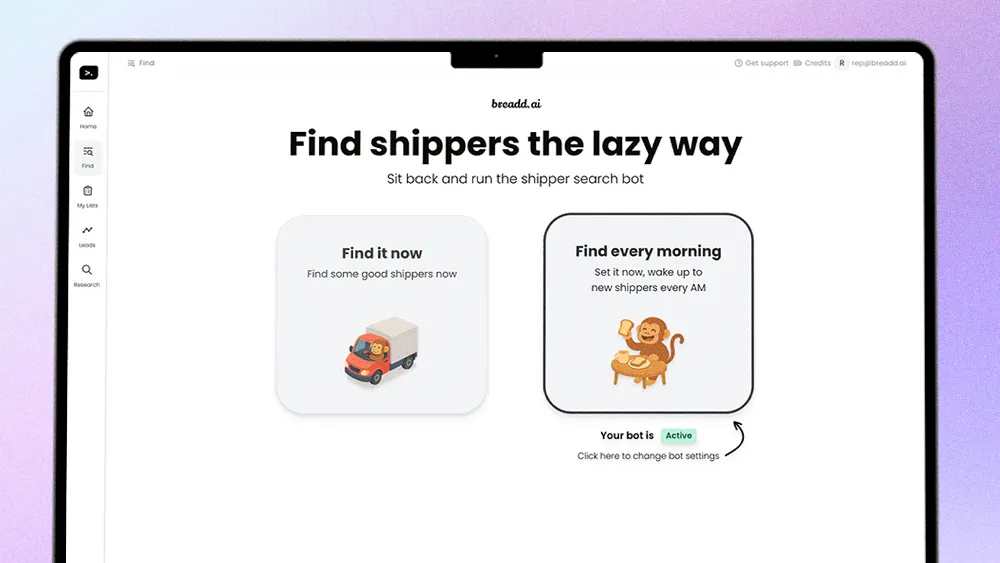
Show me the money: "The unlock for vendors is to ask, 'Does it help you make money today? Does it help you eliminate a real budget line item today?' That’s how we found success. We went from saying, 'We help you save time,' to 'We help you find business,'" Wu explains. "When we help a broker match with a shipper, that's immediate top-line revenue."
The model’s success is illustrated by a recent example: a new sales rep at a partner agency, with no prior industry experience, used the platform to land two new customers in his first month—a process that usually takes three. It’s an outcome that highlights how AI delivers value when it helps users sift through the noise and make an optimal decision in a market with high impact potential.
The chicken and egg: But even a winning value proposition isn't always enough. Wu explains that vendors must navigate a difficult market where AI agents are proliferating within what he describes as a broken buying process. Wu believes vendors have a responsibility to solve this by offering solutions that prove value before requiring deep, time-consuming integration. "How can the business manager go back with a business case to say why we should invest? It's a chicken-and-egg problem, and I think the vendors have a responsibility to clear the risk."
Beyond the hype: That chicken-and-egg problem is compounded by widespread hype fatigue. Wu’s advice for connecting with disillusioned customers? Stop talking about the technology and start talking about their problems. He points to the internet as a model for AI's future—an assumed, invisible layer that empowers a product from behind the scenes. "Another vendor in the freight industry told me he changed his email marketing language. He does A/B testing, and the emails without 'AI' in the subject line now have a much higher open rate," notes Wu. "The moment you say 'AI,' it gets spammed and shut down right away because people have seen through the hype."
Have it all: Wu frames the path forward as a simple buy-then-build discipline shaped by day-to-day reality. Instead of hiring, his team starts with low-risk point tools to remove repetitive work and prove value fast, only building in-house once the spend makes sense. "As our bills go from $10 a month to $100 to $1,000, that’s when we start automating this ourselves," he says. "We go from a 'buy' to a 'build' model." The shift also removes excuses. "If you’re doing something again and again, there’s a predictable input, process, and output," Wu adds. "Now there are low-code tools that let you stop doing it. It’s no longer a trade-off between cost and speed. You can have it all."
Wu ultimately ties the mindset shift to something bigger than tooling or workflows. He sees AI’s real promise in fixing the information gaps that keep supply and demand misaligned across logistics, with ripple effects far beyond the industry itself. "When we do have tools like what we’re building and others that can match across this mass amount of information, we’ll see the cost of transportation go down," he concludes. "At the end of the day, our personal goods and our spending goes down for our cost of living."